Charging speed Fairphone 5

I tried a different charger and cable today: my Lenovo laptop’s 65W charger.

With 20% battery, the Fairphone 5 indicated it was “charging rapidly, 1h50m left until full”. I checked a few times during the following two hours and it effectively took that long to charge.

Over the last couple of weeks, I have tried several different chargers (an Apple 61W charger, an Anker 65W charger, and an external power bank) connected to several different cables (an Apple USB-C cable, the Fairphone USB-C cable and some other USB-C cables). The usual charging time for the FP5 is three hours. I can charge other phones or tablets with these cables quite fast.

What confuses me the most is that the FP5 actually indicates “charging rapidly”, even when it indicates that it will take three hours.

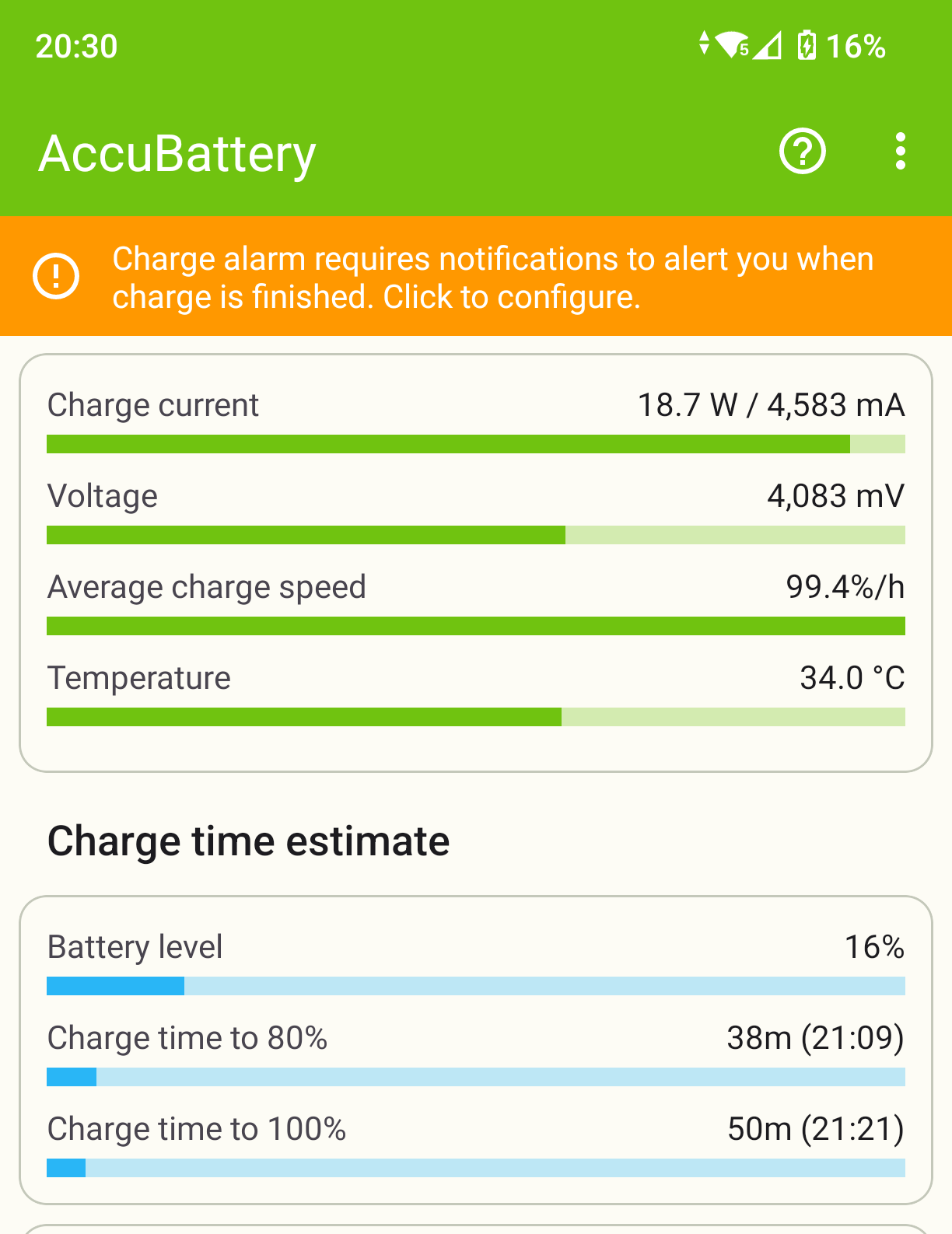
Here’s a screenshot of the estimation today:

EDIT: Apple charger was 61W, not 65W.

You might try out the AccuBattery app. It gives you some more statistical details while charging.

Might this be an OS thing as well? You are using a Fairphone 5? And which OS?
The battery settings page looks different for me on latest Fairphone OS, offering more options

With the Lenovo laptop charger (and its non-replaceable cable), AccuBattery reports a charge speed of 2016mA average with screen off. It indicates that charging completely will take 1h49m. This charger reads:

Output: 20.0⎓V 3.25A 65W / 15V⎓3A / 9V⎓2A / 5V⎓2A 10W

With an Apple 87W charger (with an Apple cable), AccuBattery reports a charging speed of 2020mA with screen off. This charger reads:

Output: 20.2V⎓4.3A (USB PD) or 9V⎓3A (USB PD) or 5.2V⎓2.4A

With a RAVPower PD 65W charger (with the FP cable), AccuBattery reports a charging speed of 2018mA with screen off. This charger reads:

Output: 5V⎓3A, 9V⎓3A, 12V⎓3A, 15V⎓3A, 20V⎓3.25A, 65W Max

Apparently, charging speed is capped at 2020mA, regardless of charger and cable that I use.

1 Like

It’s a FairPhone5 from Murena. AFAIK, the main difference is that Murena’s ship without Google tracking spyware and all other software that somehow depends on that being installed. I don’t think they’ve tinkered anything battery related.

Murena ships their phones with /e/OS which is based on LineageOS, certainly differs from what Fairphone ships their phones with themselves. If that makes any difference concerning charging I don’t know.
I have just charged my phone but I can check the max. A later today or tomorrow with AccuBattery

1 Like


Thought I’d give this app a shot, because it made me curious. I seem to be able to charge upwards of 4500mA.

4 Likes

I got similar numbers to the ones from @Nabalazs,
average Screen Off charge speed of 4420mA.

As Lineage/ /e/OS is quite different from our Fairphone OS, I would suggest you to first validate with another /e/OS user if it is an OS issue. Or otherwise, if they charge faster, a possible hardware issue (all your chargers, unlikely, or the phone itself)

Edit: @Nabalazs are you on Fairphone OS? Just realized I assumed it but you didn’t state it here

Yes I am! Everything is as stock as Fairphone sells it in europe.

The temperature of the phone/air is important too.If the battery/phone gets too warm the charging will last longer.

I’ve asked on the Murena community forums. It’ll be useful to understand if others are having the same issue or if it’s just my device.

I have experienced similar charging speed with different charges. It indicades that it charges fast even though it takes around 3h to fully charge. The same charges with another phone charges faster.

Because charger & phone need to match in what they expect.

Ok, e.g. a 60W charger could theoretically, if it’s cheap and follows some old USB-C PD Standard, offer the 60W only as 12V/5A. For that, you need the proper (thick) cable, and a phone that wants to use that profile, and not say 18V/3,3A. Cheap mobile/laptop chargers from some time ago, have the reputation to provide a very thin portfolio of voltages/currents tailored to the device they came with. Making them of limited use for other devices, either as slow chargers or in extreme cases not charging at all.

More modern chargers/USB PD standards are more flexible, e.g. allowing the devices to negotiate even variable voltages.

And last but not least, a mobile that is sold as “charging with (up to) n W” charges with n W usually only during a short moment in the sweet spot of the charging curve, while at the start and especially at the end it’s rather slow charging.

And there you get the secret why two 30W chargers can potentially take quite different times charging a phone, model A uses an older PD protocol or even QC3. with few fixed voltage/current profiles, model B offers the mobile a big voltage range and any current draw with it, that it might request, so yes, the phone can basically draw it’s ideal charging curve all the time, limited only by battery temp, instead of being forced to pick suboptimal V/A choices.

That’s what makes USB-C so irritating from times to times.

The fact that manufacturers like Fairphone don’t specify which charging protocols are supported by the FP does not help.

What kind of specification is “can be charged in 20 minutes 50% with a 30W charger”?

20->70%? 0->50%? 50->100%? (Hint all these ranges in practice take different times, for the reason see above)

QC3 30W charger? USB-C PD 3.0 charger? USB-C PD 3.1 charger? Only the original Fairphone charger and chargers that luckily happen to have compatible specs?

(Funny the specs of the Fairphone charger does not mention if it does PD, QC, and which versions either. It only mentions it’s compatible with all Fairphones and all devices with a USB-A/USB-C connector. Hahaha)

Anyway, regards.

Andreas

About Fairphone and Fairphone charger:

The phone specs concerning charging are specified in detail on their website
(Fairphone 5 supports QC 4+ and all QC below)

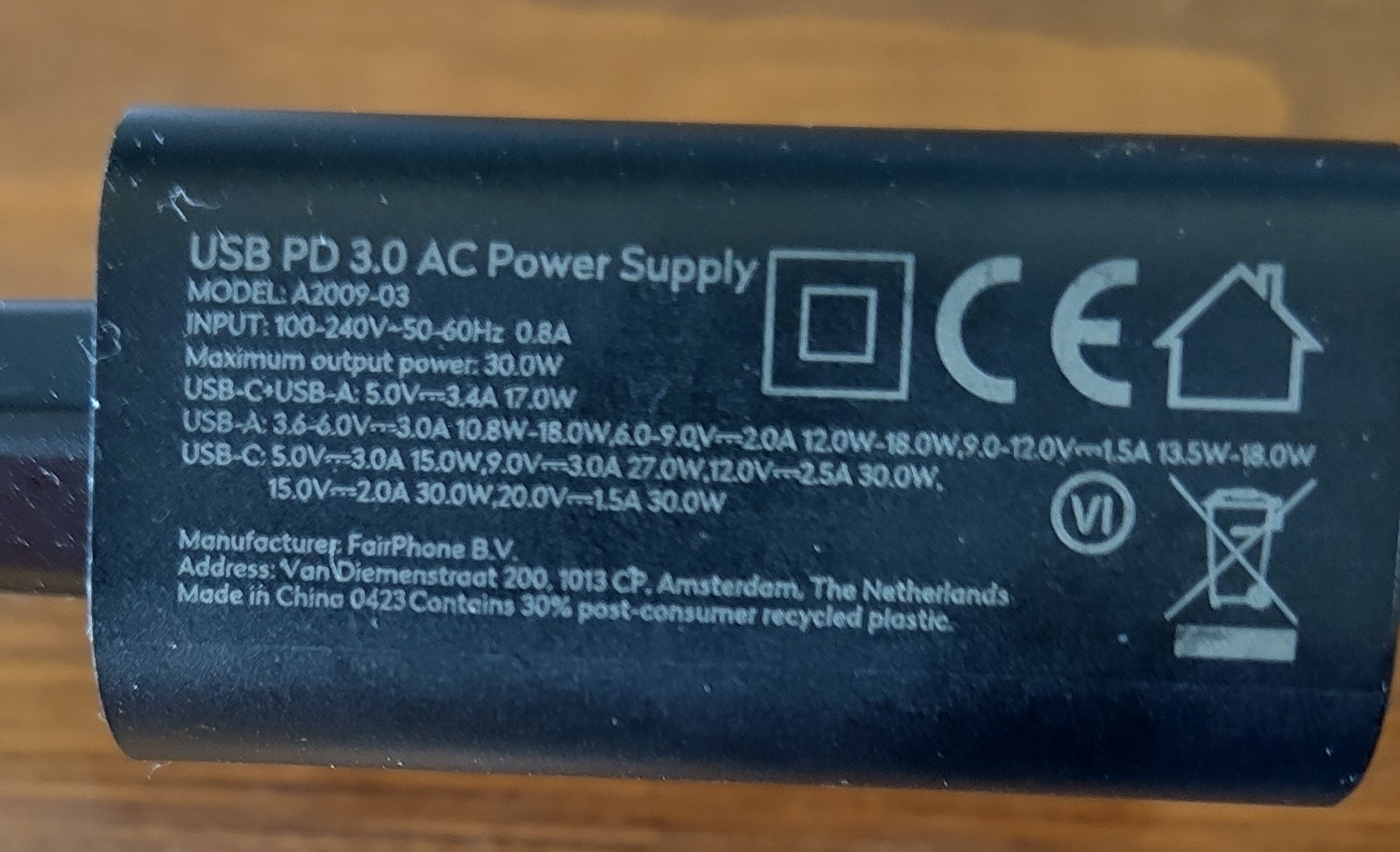
The charger specs are sadly not documented. Therefore as picture of my charger:

To figure out now if your quick chargers do the same speed as the one reached with the original charger, check what your charger can supply and if it is at any standards the phone eats and preferably with 30W

Ah, so it’s a USB-PD charger, according to the Wikipage linked there on QC, USB-PD can deliver at most 27W to QC4+ devices.

Anyway it’s less a question of the maximum power, as it’s applied only for a short time during the charging.

To optimize charging you would need a QC4+ charger or USB-C charger with PPS (programmable power setting), then the phone can perfectly align its requirements with what the charger is sending.

Not really, according to the USB-C PD consortium, up to 60W any cable will do:

I guess Fairphone knows (better)…

For quick charge

  • Maximum output of 4 amperes (4A, 4000mA). Note: the cable must also support 4A to charge at total capacity.

I would like to emphasize:

USB-C+USB-A: 5.0V= 3.4A 17.0W

Imho this means: If you connect 2 devices 5V only is available.

I have experienced two different charging behaviours with two different FP5 - due to RMA - on exactly the same chargers and cables. My chargers are old ones, a 15 watt Samsung charger and a 20 watt Apple charger. On the Samsung charger its 15 watt are too little to say something about charging speed. On the Apple charger with its 20 watt I would say the new FP5 charges a bit slower than the returned FP5. I never measured the time. FP5 fast charging mode was activated of course. When migrating from old to new FP5 the firmware was the same as well. But with the old (returned) FP5 I used an 100 watt powerbank in case a fast charging was needed, so the FP5 could use its 30 watt charging limit. It did and that was a real help. But the new FP5 is by far not that fast anymore. As I said, all chargers, cables and the powerbank stayed the same, no parts ever changed.