Originally published at: "As a tech leader, please check yourself." - Fairphone by Raymond van Eck, ceo Fairphone.
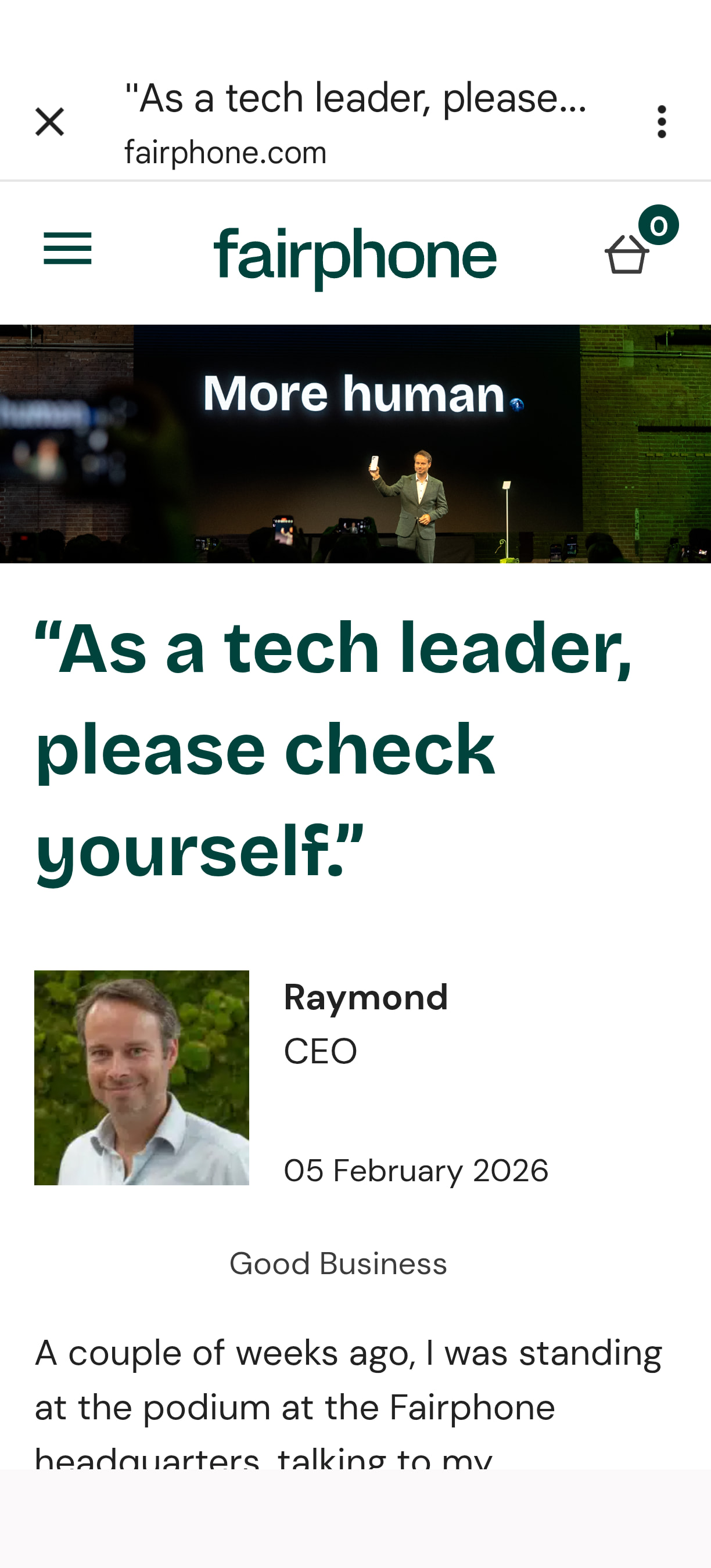
A couple of weeks ago, I was standing at the podium at the Fairphone headquarters, talking to my colleagues about our performance in the last quarter of 2025. And while I stood there, I had to take a moment to appreciate just the sheer diversity of the faces staring back at me. We’re not a big team at Fairphone, the running joke at the office is that Fairphone’s total number of employees is probably smaller than the marketing department at Apple. And yet, our workforce spreads over 32 different nationalities, something that always astounds me.
And then I look at myself.
Male. White. Heterosexual.
Have I become the stereotype?
The Seven Checkboxes
Industry data is quite telling. The Business of Tech released their Q4 2025 IT Leadership data, and the numbers show that about 83% of IT leaders are white. Roughly four out of five IT leaders are men, while women occupy a little over 21% of leadership roles. What’s worse, this data confirms a trend the report calls the Five-Year Stall. Meaning the situation has remained roughly the same over the last five years.
This tracks. There’s a famous Dutch anthropologist, journalist and author called Joris Luyendijk, who has spent a considerable amount of his time looking into power dynamics and social hierarchies. The end result of this research was a rather interesting book he called De Zeven Vinkjes (or the Seven Checkboxes). The logline? In the Netherlands (and arguably across the west), power structures are dominated by people who check seven specific boxes: Male, White, Heterosexual, Highly Educated, Parents Highly Educated, Native-born, and Secular/Protestant background. The assumption is that if you tick all seven, you enter the job market with unearned privileges, and moving up the corporate ladder becomes less of a struggle compared to colleagues who don’t. While others face headwinds, you get a tailwind.
I tick all the boxes.
“But I’m a nice guy.”
Let me clarify. It’s not that I am not a nice guy. I like to think that my team sees me as approachable, open-minded, and honest. At Fairphone, we don’t have large offices that are blocked for the C-suite. It’s an open layout; everyone’s free to walk up to anyone and start a conversation. And that’s probably true for a lot of other tech companies.
It’s not enough, though. To think that it is is to fall into a trap. And it’s a trap that ends up alienating you even more from your colleagues, in spite of your best intentions.

Fairphone’s 150+ workforce hails from over 32 different nationalities.
Self-awareness AT ALL TIMES is key
It doesn’t matter how ‘open’ and ‘accessible’ I feel. As someone in a position of influence, I need to be constantly aware of how others perceive me. When I’m sitting across the table from any of my colleagues, I need to see myself through their eyes. No matter how ‘nice’ a guy I am, I am still the ‘norm’ that the system favors. When I look at myself like that, it’s easy to see how quickly I can be perceived as the seven checkboxes incarnate.
So how does one break that perception?
Being aware of your privilege is half the battle won. The other half lies in checking said privilege. Every day, I need to remind myself that my normal is only my normal. I cannot qualify other people’s lived experience through my eyes. And as someone who travels across three different continents for work, this is a very important thing to keep in mind for me. I cannot change where I come from, but I can be actively aware of it. I should be. At all times.
Stop treating others like you want to be treated
It’s the golden rule. Treat others like you want to be treated. It’s what many religions have espoused for centuries. It’s recommended for good leadership to make people in positions of influence more empathetic, kinder, more sensitive.
It just makes sense. Right?
Well, not really. Not anymore. Authors Michael O’Connor and Tony Alessandra have written a highly entertaining book called The Platinum Rule that explains this best. The book outlines the main fallacy with the golden rule, which is that it assumes everyone has the same likes, dislikes, goals, ambitions, and circumstances. It starts from a place of commonality. Everyone has one common lived experience. But as the world grows smaller, and workforces grow more and more diverse every day, the golden rule is becoming increasingly irrelevant. Instead, switch to the platinum rule. Treat others the way they want to be treated, not the way you would want to be treated. You might not intend to, but what happens with the golden rule is that you are enforcing your worldview on them. True inclusivity requires you to step entirely into their perspective. Because it’s not about you, it’s about them. Step into their shoes fully.
Policies are good. A behavioral shift is better.
What I’m talking about isn’t hard to implement. It takes very little time and energy to be a bit more mindful. And while policies are great to enforce these concepts, a behavioral shift is more sustainable in the long run. We’re talking about building a culture of empathy, a culture of checking your privilege. Inclusion happens in the moments between the rules, in how we listen, and in how we perceive the person across from us. At Fairphone, we have an extremely active DEI committee that is constantly looking for ways to make sure everyone across the company is heard and feels represented. But for me, as one of the leaders of this wonderful mission-driven enterprise, there’s always more I can do. All I have to do is listen.

 !
!


